Powered By Blogger

Thursday, 18 December 2014

Lithophile,siderophile,atmophile and chalcophile

Lithophile elements

Lithophile elements are those that remain on or close to the surface because they combine readily with oxygen, forming compounds that do not sink into the core. The lithophile elements include: Al, At, B, Ba, Be, Br, Ca, Cl,Cr, Cs, F,I, Hf, K, Li, Mg, Na, Nb, O, P, Rb, Sc, Si,Sr, Ta, Tc, Th, Ti, U, V, Y, Zr, W and thef-block lanthanides.
Lithophile elements mainly consist of the highly reactive metals of the s- and f-block. They also include a small number of reactive nonmetals, and the more reactive metals of the d-block such as titanium, zirconium and vanadium. Lithophile derives from "lithos" which means "rock", and "phile" which means "love".
Most lithophile elements form very stable ions with an electron configuration of a noble gas (sometimes with additional f-electrons). The few that do not, such as silicon, phosphorus and boron, form extremely strong covalent bonds with oxygen – often involving pi-bonding . Their strong affinity for oxygen causes lithophile elements to associate very strongly with silica, forming relatively low-density minerals that thus float to the crust. The more soluble minerals formed by the alkali metals  tend to concentrate in seawater or extremely arid regions where they can crystallise. The less soluble lithophile elements are concentrated on ancient continental shields where all soluble minerals have been weathered.
Because of their strong affinity for oxygen, most lithophile elements are enriched in the Earth's crust relative to their abundance in the solar system. The most reactive s- and f-block metals, which form either saline or metallic hydrides, are known to be extraordinarily enriched on Earth as a whole relative to their solar abundances. This is because during the earliest stages of the Earth's formation the reaction that controlled the stable form of each chemical element was its ability to form compounds with hydrogen. Under these conditions, the s- and f-block metals were strongly enriched during the formation of the Earth. The most enriched elements are rubidium, strontium and barium, which between them account for over 50 percent by mass of all elements heavier than iron in the Earth's crust.
The nonmetallic lithophiles – phosphorus and the halogens  – exist on Earth as ionic salts with s-block metals in pegmatites  and seawater. With the exception of fluorine, whose hydride forms hydrogen bond and is therefore of relatively low volatility, these elements have had their concentrations on Earth significantly reduced through escape of volatile hydrides during the Earth's formation. Although they are present in the Earth's crust in concentrations quite close to their solar abundances, phosphorus and the heavier halogens are probably significantly depletedon Earth as a whole relative to their solar abundances.
Several transition metals, including chromium, molybdenum, iron and manganese, show both lithophile andsiderophile characteristics and can be found in both these two layers. Although these metals form strong bonds with oxygen and are never found in the Earth's crust in the free state, metallic forms of these elements are thought very likely to exist in the core of the earth as relics from when the atmosphere did not contain oxygen. Like the "pure" siderophiles, these elements (except iron) are considerably depleted in the crust relative to their solar abundances.
Owing to their strong affinity for oxygen, lithophile metals, although they form the great bulk of the metallic elements in Earth's crust, were never available as free metals before the development of elcetroelectrolysis . With this development, many lithophile metals are of considerable value as structural metals (magnesium, aluminium, titanium, vanadium) or as reducing agents (sodium, magnesium, calcium). The process of smelting  these metals is extremely energy-intensive. With emissions of greenhouse gases suspected of contributing to climate changes, the use of these elements as industrial metals is called into question, despite the depletion of rarer and less reactive chalcophile metals leaving few substitutes.
The non-metals phosphorus and the halogens were also not known to early chemists, though production of these elements is less difficult than of metallic lithophiles since electrolysis is required only with fluorine. Elemental chlorine is particularly important as an oxidizing agent – usually being made by electrolysis of NaCl.

Siderophile elements


Abundance (atom fraction) of the chemical elements in Earth's upper continental crust as a function of atomic number. The rarest elements in the crust (shown in yellow) are not the heaviest, but are rather the siderophile (iron-loving) elements in the Goldschmidt classification of elements. These have been depleted by being relocated deeper into the Earth's core. Their abundance in meteorid materials is relatively higher. Additionally, tellurium and selenium have been depleted from the crust due to formation of volatile hydrides.
Siderophile (from sideron, "iron", and philia, "love") elements are the high-density transition metals  which tend to sink into the core because they dissolve readily in iron either as solid solutions or in the molten state.
The siderophile elements include gold, cobalt,iron,iridium,Mn, molybdenum,Ni, osmium, palladium, Pt, rhenium,rhodium and ruthenium.
Most siderophile elements have practically no affinity whatsoever for oxygen: indeed oxides of gold are thermodynamically unstable with respect to the elements. They form stronger bonds with carbon or sulfur, but even these are not strong enough to separate out with the chalcophile elements. Thus, siderophile elements are bound through metallic bonds with iron in the dense layer of the Earth's core where pressures may be high enough to keep the iron solid. Manganese, iron and molybdenum do form strong bonds with oxygen but in the free state (as they existed on the primitive earth when free oxygen did not exist) can mix so easily with iron that they do not concentrate in the siliceous crust as do true lithophile elements. However, ores of manganese are found in much the same sites as are those of aluminium and titanium owing to manganese's great reactivity towards oxygen.
Because they are so concentrated in the dense core, siderophile elements are known for their rarity in the Earth's crust. Most of them have always been known as precious metals because of this. Iridium is the rarest transition metal occurring within the Earth's crust, with an abundance by mass of less than one part per billion. Mineable deposits of precious metals usually form as a result of the erosion of ultramafic rocks, but are not highly concentrated even compared to their crustal abundances, which are typically several orders of magnitude below their solar abundances. However, because they are concentrated in the mantle and core, siderophile elements are believed to be present in the Earth as a whole (including the core) in something approaching their solar abundances.

Chalcophile elements

The chalcophile elements include: Ag, As, Bi,Cd,Cu, Ga, Ge, Hg, In, Pb, Po, S, Sb, Se, Sn, Te,Tl and Zn.
Chalcophile elements are those that remain on or close to the surface because they combine readily with sulfur and/or some other chalcogen other than oxygen, forming compounds which do not sink into the core.
Chalcophile elements are those metals and heavier nonmetals that have a low affinity for oxygen and prefer to bond with sulfur as highly insoluble sulfides. Chalcophile derives from Greek khalkós (χαλκός), meaning "ore" (it also meant "bronze" or "copper", but in this case "ore" is the relevant meaning), and is taken to mean "chalcogen-loving" by various sources.
Because these sulfides are much denser than the silicate minerals formed by lithophile elements, chalcophile elements separated below the lithophiles at the time of the first crystallisation of the Earth's crust. This has led to their depletion in the Earth's crust relative to their solar abundances, though because the minerals they form are nonmetallic, this depletion has not reached the levels found with siderophile elements.
However, because they formed volatile hydrides on the primitive Earth when the controlling redox reaction was the oxidation or reduction of hydrogen, the less metallic chalcophile elements are strongly depleted on Earth as a whole relative to cosmic abundances. This is most especially true of the chalcogens selenium and tellurium, which for this reason are among the rarest elements found in the Earth's crust (to illustrate, tellurium is only about as abundant as platinum).
The most metallic chalcophile elements (of the copper, zinc and boron groups) may mix to some degree with iron in the Earth's core. They are not likely to be depleted on Earth as a whole relative to their solar abundances since they do not form volatile hydrides. Zinc and gallium are somewhat "lithophile" in nature because they often occur in silicate or related minerals and form quite strong bonds with oxygen. Gallium, notably, is sourced mainly from bauxite, an aluminum hydroxide ore in which gallium ion substitutes for chemically similar aluminum.
Although no chalcophile element is of high abundance in the Earth's crust, chalcophile elements constitute the bulk of commercially important metals. This is because, whereas lithophile elements require energy-intensive electrolysis for extraction, chalcophiles can be easily extracted by reduction with coke, and chalcophiles' geochemical concentration – which in extreme cases can exceed 100,000 times average crustal abundance. These greatest enrichments occur in high plateaux like the Tibetan Plateau  and the Bolivian altiplano where large quantities of chalcophile elements have been uplifted through plate collisions. A side-effect of this in modern times is that the rarest chalcophiles (like mercury) are so completely exploited that their value as minerals has almost completely disappeared.

Atmophile elements

The atmophile elements are: H, C,N and the noble gases.
Atmophile elements (also called "volatile elements") are defined as those that remain mostly on or above the surface because they are, or occur in, liquids and/or gases at temperatures and pressures found on the surface. The noble gases do not form stable compounds and occur as monatomic gases, while nitrogen, although it does not have a stable configuration for its individual atoms, forms a diatomic molecule so strong that all oxides of nitrogen are thermodynamically unstable with respect to nitrogen and oxygen. Consequently, with the development of free oxygen through photosynthesis,ammonia was oxidised to molecular nitrogen which has come to form four-fifths of the Earth's atmosphere. Carbon is also classed as an atmophile because it forms very strong multiple bonds with oxygen in carbon monoxide (slowly oxidised in the atmosphere) and carbon dioxide. The latter is the fourth-largest constituent of the Earth's atmosphere, while carbon monoxide occurs naturally in volcanoes and has a residence time in the atmosphere of a few months.
Hydrogen, which occurs in the compound water, is also classed as an atmophile. Water is classified as a volatile, because most of it is liquid or gas, even though it does exist as a solid compound on the surface.
Because all atmophile elements are either gases or form volatile hydrides, atmophile elements are strongly depleted on earth as a whole relative to their solar abundances owing to losses from the atmosphere during the formation of the Earth. The heavier noble gases (krypton, xenon) are the rarest stable elements on Earth

Wednesday, 17 December 2014

Meteorites


Meteorites
On February 15, 2013 a meteor exploded in the sky over Chelyabinsk, southern Russia.  Although no people or buildings were hit by the resulting meteorite, the shockwave from the exploding object injured about 1500 people and caused damage to 7200 buildings in the region.  The fireball and was caught on video, mainly by dash cameras throughout the region, which were posted on the internet by news organizations individuals.  Although the Chelyabinsk meteorite probably weighed about 12,000–13,000 metric tonnes, and measured 17 to 20 m in diameter before it exploded, sientists were quick to point out that it was very small compared to other objects that could potentially hit the earth.   The explosion released energy estimated at about 500 kilotons of TNT (about 20 to 30 times more energy than the Hiroshima atomic bomb).  The event brought to the world's attention the very real hazards associated with the impact of objects from outer space. 
A Meteorite is a piece of rock from outer space that strikes the surface of the Earth.
A Meteoroid is a meteorite before it hits the surface of the Earth.
Meteors are glowing fragments of rock matter from outside the Earth's atmosphere that burn and glow upon entering the Earth's atmosphere.  They are more commonly known as shooting stars.  Some meteors, particularly larger ones, may survive passage through the atmosphere to become meteorites, but most are small objects that burn up completely in the atmosphere.  They are not, in reality, shooting stars.
Fireballs  are very bright meteors.
Meteor Showers - During certain times of the year, the Earth's orbit passes through a belt of high concentration of cosmic dust and other particles, and many meteors are observed.  The Perseid Shower, results from passage through one of these belts every year in mid-August, and Leonid shower occurs in mid-November.
Throughout history there have been reports of stones falling from the sky, but the scientific community did not recognize the extraterrestrial origin of meteorites until the 1700s.  Within recent history meteorites have even hit humans-
  • 1938 - a small meteorite crashed through the roof of a garage in Illinois
  • 1954 - A 5kg meteorite fell through the roof of a house in Alabama.
  • 1992 - A small meteorite demolished a car near New York City.
  • 2003 - A 20 kg meteorite crashed through a 2 story house in uptown New Orleans
  • 2003 - A shower of meteorites destroyed several houses and injured 20 people in India
Meteorite fragments have been found all over the surface of the Earth, although most have been found in Antarctica.  In Antarctica they are easily seen on the snow covered surface or embedded in ice.
The fall of meteorites to the Earth's surface is part of the continuing process of accretion of the Earth from the dust and rock of space.  When these rock fragments come close enough to the Earth to be attracted by its gravity they may fall to the Earth to become part of it.  As we will see the evolution of life on the Earth has likely been affected by collisions with these space objects, and collisions could affect the Earth in the future as well.


Composition and Classification of Meteorites
Meteorites can be classified generally into three types:
  • Stones - Stony meteorites resemble rocks found on and within the Earth. They are the most common type of meteorite, although because they resemble Earth rocks they are not commonly recognized as meteorites unless someone actually witnesses their fall.  Stony meteorites are composed mainly of the minerals olivine, and pyroxene.  Some have a composition that is roughly equivalent to the Earth's mantle.  Two types are recognized:
    • Chondrites - Chondrites are the most common type of stony meteorite. They are made of olivine, pyroxene, and iron - nickel alloys that are magnetic.   They are composed of small round spheres, called chondrules, made of the minerals olivine and pyroxene. They appear to have formed by rapid melting followed by rapid cooling early in the history of the solar system. Most chondrites have radiometric age dates of about 4.6 billion years.  
    • Achondrites - Achondrites are composed of the same minerals as chondrites, but lack the chondrules. They appear to have been heated, melted, and recrystallized so that the chondrules are no longer present.  Most resemble igneous rocks found on the Earth.
  • Irons - Iron meteorites are composed of alloys of iron and nickel. They are easily recognized because they have a much higher density than normal crustal rocks. Thus, most meteorites found by the general populace are iron meteorites. All are magnetic. When cut and polished, iron meteorites show a distinct texture called a Widmanstätten pattern.  This pattern results from slow cooling of a once hot solid material.  Most research suggest that such slow cooling occurred in the core of much larger body that has since been fragmented. Iron meteorites give us a clue to the composition of the Earth's core.
  • Stony Irons - Stony iron meteorites consist of a mixture of stony silicate material and iron.  Some show the silicates embedded in a matrix of iron-nickel alloy. Others occur as a breccia, where fragments of stony and iron material have been cemented together by either heat or chemical reactions.


Origin of MeteoritesMost meteorites appear to be fragments of larger bodies called parent bodies.  These could have been small planets or large asteroids that were part of the original solar system.  There are several possibilities as to where these parent bodies, or their fragments, originated.
  • The Asteroid Belt
    The asteroid belt is located between the orbits of Mars and Jupiter.  It consists of a swarm of about 100,000 objects called asteroids.  Asteroids are small rocky bodies with irregular shapes that have a cratered surface.  About 4,000 of these asteroids have been officially classified and their orbital paths are known.  Once they are so classified they are given a name.  

The asteroids are either remnants of a planet that formed in the region between Mars and Jupiter but was later broken up by a collision with another planetary body, or are fragments that failed to accrete into a planet.  The latter possibility is more likely because the total mass of the asteroids is not even equal to our moon.  It does appear that some of the asteroids are large enough to have undergone internal differentiation.  Differentiation is a process that forms layering in a planetary body (i.e. the Earth has differentiated into a core, mantle, and crust). If these larger asteroids did in fact undergo differentiation, then this could explain the origin of the different types of meteorites.  Because of the shapes of the asteroids it also appears that some of them have undergone fragmentation resulting from collisions with other asteroids.  Such collisions could have caused the larger bodies to be broken up into the smaller objects we observe as meteorites.
  • The Asteroids as Parent Bodies of Meteorites
Much evidence suggests that the asteroids could be the parent bodies of meteorites. The larger ones could have differentiated into a core, mantle, and crust. Fragmentation of these large bodies would then have done two things:  First the fragments would explain the various types of meteorites found on Earth - the stones representing the mantle and crust of the original parent body, the irons representing the cores, and the stony irons the boundary between the core and mantle of the parent bodies. Second, the collisions that caused the fragmentation could send the fragments into Earth-crossing orbits.
Some of the asteroids have orbits that bring them close to Earth.  These are called Amor objects.  Some have orbital paths that cross the orbital path of the Earth.  These are calledEarth-crossing asteroids or Apollo objects.  All objects that have a close approach to the Earth are often referred to as Near Earth Objects orNEOs.  About 150 NEOs with diameters between 1 and 8 km are known, but this is only a fraction of the total number.  Many NEOs will eventually collide with the Earth.  These objects have unstable orbits because they are under the gravitational influence of both the Earth and Mars.  The source of these objects is likely the asteroid belt.


  • Comets as Parent Bodies of Meteorites
  • A Comet is a body that orbits around the Sun with an eccentric orbit. These orbits are not circular like those of the planets and are not necessarily within the same plane as the planets.  Most comets have elliptical orbits which send them to the far outer reaches of the solar system and back toward a closer approach to the sun. As a comet approaches the sun, solar radiation generates gases from evaporation of the comet's surface. These gases are pushed away from the comet and glow in the sun light, thus giving the comet its tail. While the outer surface of comets appear to composed of icy material like water and carbon dioxide solids, they likely contain a more rocky nucleus.  Because of their eccentric orbits, many comets eventually cross the orbit of the Earth.  Many meteor showers may be caused by the Earth crossing an orbit of a fragmented comet.
The collision of a cometary fragment is thought to have occurred in the Tunguska region of Siberia in 1908.  The blast was about the size of a 15 megaton nuclear bomb.  It knocked down trees in an area about 850 square miles, but did not leave a crater.  Although still controversial, the general consensus among scientists is that a cometary fragment about 20 to 60 meters in diameter exploded in the Earth's atmosphere just above the Earth's surface. A similar event if it happened over a large city, would be devastating.
Tunguska.GIF (12149 bytes)


  • Other Sources

    While the asteroid belt seems like the most likely source of meteorites, some meteorites appear to have come from other places.  Some meteorites have chemical compositions similar to samples brought back from the moon. Others are thought to have originated on Mars. These types of meteorites could have been ejected from the Moon or Mars by collisions with other asteroids, or from Mars by volcanic eruptions.

Impact Events
When a large object impacts the surface of the Earth, the rock at the site of the impact is deformed and some of it is ejected into the atmosphere to eventually fall back to the surface.  This results in a bowl shaped depression with a raised rim, called anImpact Crater.  The size of the impact crater depends on such factors as the size and velocity of the impacting object and the angle at which it strikes the surface of the Earth.
Meteorite Flux and Size
Meteorite flux
 is the total mass of extraterrestrial objects that strike the Earth.  This is currently about 107 to 109kg/year. Much of this material is dust-sized objects called micrometeorites.   The frequency at which meteorites of different sizes strike the Earth depends on the size of the objects, as shown in the graph below.  Note the similarity between this graph and the flood recurrence interval graphs we looked at in our discussion of flooding. 
Tons of micrometeorites strike the Earth each day. Because of their small size, they do not usually burn up when entering the Earth's atmosphere, but instead settle slowly to the surface. Meteorites with diameters of about 1 mm strike the Earth about once every 30 seconds.  Upon entering the Earth's atmosphere the friction of passage through the atmosphere generates enough heat to melt or vaporize the objects, resulting in so called shooting stars.
 
Meteorites of larger sizes strike the Earth less frequently.  If they have a size greater than about 2 or 3 cm, they only partially melt or vaporize on passage through the atmosphere, and thus strike the surface of the Earth.

Objects with sizes greater than 1 km are considered to produce effects that would be catastrophic, because an impact of such an object would produce global effects.  Such meteorites strike the Earth relatively infrequently -  a 1 km sized object strikes the Earth about once every million years, and 10 km sized objects about once every 100 million years.
Velocity and Energy Release of Incoming Objects
The velocities at which small meteorites have impacted the Earth range from 4 to 40 km/sec.  Larger objects would not be slowed down much by the friction associated with passage through the atmosphere, and thus would impact the Earth with high velocity. Calculations show that a meteorite with a diameter of 30 m, weighing about 300,000 tons, traveling at a velocity of 15 km/sec (33,500 miles/hour) would release energy equivalent to about 20 million tons of TNT.  

Such a meteorite struck at Meteor Crater, Arizona (the Barringer Crater) about 49,000 years ago leaving a crater 1200 m in diameter and 200 m deep.
The amount of energy released by an impact depends on the size of the impacting body and its velocity.
E = ½ MV2
where E = Energy, M = Mass (depends on size and density of the object), and V = Velocity


An impact like the one that struck the Yucatan Peninsula, in Mexico about 65 million years ago, thought responsible for the extinction of the dinosaurs and numerous other species, created the Chicxulub Crater, 180 km in diameter and released energy equivalent to about 100 million megatons of TNT. impactenergy.gif (14030 bytes)


For comparison, the amount of energy needed to create a nuclear winter on the Earth as a result of nuclear war is about 8,000 megatons, and the energy equivalent of the world's nuclear arsenal is about 60,000 megatons.


Cratered Surfaces
Looking at the surface of the Moon, one is impressed by the fact that most of the surface features of the moon are shaped by impact craters.  The Earth is subject to more than twice the amount of impacting events than the moon because of its larger size and higher gravitational attraction. Yet, the Earth does not show a cratered surface like the moon.  The reason for this is that the surface of the Earth is continually changing due to processes like erosion, weathering, tectonism, sedimentation, and volcanism.  Thus, the only craters that are evident on the Earth are either very young, very large, or occurred on stable continental areas that have not been subject to intense surface modification processes.  Currently, approximately 200 terrestrial impact structures have been identified, with the discovery rate of new structures in the range of 3-5 per year. 


The Mechanics of Impact Cratering
When a large extraterrestrial object enters the Earth's atmosphere the initial impact with the atmosphere will compress the atmosphere, sending a shock wave through the air.  Frictional heating will cause the object to heat and glow.  Melting and even vaporization of the outer parts of the object will begin, but if the object is large enough, solid material will remain when it impacts the surface of the Earth. 


Impacts of large meteorites have never been observed by humans.  Much of our knowledge about what happens next must come from scaled experiments.  As the solid object plows into the Earth, it will compress the rocks to form a depression and cause a jet of fragmented rock and dust to be expelled into the atmosphere. This material   is called ejecta.  The impact will send a shock wave into the rocks below, and the rocks will be crushed into small fragments to form a breccia.  Some of the ejecta will be hot enough to vaporize, and the heat generated by the impact could be high enough to actually melt the rock at the site of the impact.   The shock wave entering the Earth will first move in as a compressional wave (P-wave), but after passage of the compressional wave an expansion wave (rarefaction wave) will move back toward the surface.  This will cause the floor of the crater to be uplifted and may also cause the rock around the rim of the crater to bent upward.  Faulting may also occur in the rocks around the crater, causing the crater to become enlarged, and have a concentric set of rings.impactcrater.gif (31002 bytes)


The ejecta will eventually settle back to the Earth's surface forming an ejecta blanketthat is thick near the crater rim and thins outward from the crater.   Rocks below the crater that were not melted by the impact will be intensely fractured.  All of this would happen in a matter of 1 to 2 minutes.
 
Meteorite Impacts and Mass Extinctions
The impact of a space object with a size greater than about 1 km would be expected to be felt over the entire surface of the Earth.  Smaller objects would certainly destroy the ecosystem in the vicinity of the impact, similar to the effects of a volcanic eruption, but larger impacts could have a worldwide effect on life on the Earth. We will here first consider the possible effects of an impact, and then discuss how impacts may have resulted in mass extinction of species on the Earth in the past.
Regional and Global EffectsAgain, we as humans have no firsthand knowledge of what the effects of an impact of a large meteorite (> 1 km in size) or comet would be.  Still, calculations can be made and scaled experiments can be conducted to estimate the effects. The general consensus is summarized here.
  1. Massive earthquake - up to Richter Magnitude 13, and numerous large magnitude aftershocks would result from the impact of a large object with the Earth.
  2. The large quantities of dust put into the atmosphere would block incoming solar radiation. The dust could take months to settle back to the surface.  Meanwhile, the Earth would be in a state of continual darkness, and temperatures would drop throughout the world, generating global winter like conditions. A similar effect has been postulated for the aftermath of a nuclear war (termed a nuclear winter).  Blockage of solar radiation would also diminish the ability of photosynthetic organisms, like plants, to photosynthesize. Since photosynthetic organisms are the base of the food chain, this would seriously disrupt all ecosystems.
  3. Widespread wildfires ignited by radiation from the fireball as the object passed through the atmosphere would be generated.  Smoke from these fires would further block solar radiation to enhance the cooling effect and further disrupt photosynthesis.
  4. If the impact occurred in the oceans, a large steam cloud would be produced by the sudden evaporation of the seawater.  This water vapor and CO2 would remain in the atmosphere long after the dust settles.  Both of these gases are greenhouse gases which scatter solar radiation and create a warming effect.  Thus, after the initial global cooling, the atmosphere would undergo global warming for many years after the impact.
  5. If the impact occurred in the oceans, giant tsunami would be generated.  For a 10 km-diameter object the leading edge would hit the seafloor of the deep ocean basins before the top of the object had reached sea level.  The tsunami from such an impact is estimated to produce waves from 1 to 3 km high.  These could easily flood the interior of continents.
  6. Large amounts of nitrogen oxides would result from combining Nitrogen and Oxygen in the atmosphere due to the shock produced by the impact.  These nitrogen oxides would combine with water in the atmosphere to produce nitric acid which would fall back to the surface as acid rain, resulting in the acidification of surface waters.
The Geologic Record of Mass Extinction
It has long been known that extinction of large percentages families or species of organisms have occurred at specific times in the history of our planet.  Among the mechanisms that have been suggested to have caused these mass extinctions have been large volcanic eruptions, changes in climatic conditions, changes in sea level, and, more recently, meteorite impacts.  While the meteorite impact theory of mass extinctions has become accepted by many scientists for particular extinction events, there is still considerable controversy among scientists. In this course we will accept the possibility that an impact with a large object could have caused at least some of the mass extinction events, as it would certainly seem possible given the effects that an impact could have, as discussed above.  Still, because of their are many other possibilities for the cause of mass extinctions, please read your book  for the arguments against the impact theory.


Major extinction events occurred at
  • the end of the Tertiary Period, 1.6 million years (m.y.) ago.
  • the end of the Cretaceous Period, marking the boundary between the Cretaceous and Tertiary periods 65 m.y. ago. (Geologists use the letter K to stand for Cretaceous Period and the letter T for the Tertiary Period. Thus this boundary is commonly called the K-T boundary).
  • the end of the Triassic, 208 m.y. ago.
  • the end of the Permian, 245 m.y. ago (estimated that over 96% of the species alive at the time became extinct).
  • the end of the Devonian, 360 m.y. ago
  • the end of Ordovician, 438 m.y. ago
  • the end of the Cambrian period, 505 m.y. ago
massextinct.gif (17849 bytes)
The mass extinction at the end of the Mesozoic Era, that is the Cretaceous - Tertiary boundary (often called the K-T boundary) 65 million years ago, shows much evidence that it was related to an impact with an extraterrestrial object. This event resulted in the extinction of over 50% of the species living at the time, including the dinosaurs. In 1978 a group of scientist led by Walter Alvarez of the University of California, Berkeley, were able to locate the K-T boundary very precisely in layers of limestones near Gubbio, Italy. At the boundary they found a thin clay layer.  Chemical analysis of the clay revealed that it contains an anomalously high concentration of the rare element Iridium (Ir).  Ir has extremely low concentrations in most crustal rocks, however it reaches very high concentrations in meteorites.  The only other possible source of high concentrations of Ir is basaltic magmas.  Over the next several years, the K-T boundary was located at several other sites throughout the world, and also found to have a thin clay layer with high concentrations of Ir.  Although a large eruption of basaltic magma could not immediately be ruled out as the source of the high concentration of Ir, other evidence began to accumulate that the fallout of impact ejecta had been responsible for both the thin clay layers and the high concentrations of Ir.  Among the evidence found at different localities where the K-T boundary is exposed is:
  • Clay layers at some localities have a high proportion of black carbon that could have originated as soot produced by wildfires set off by an impact.
  • Some of the clay layers contain grains of quartz with a crystal structure that shows evidence that the quartz was severely strained by a large shock.
  • In some clay layers tiny grains of  the mineral stishovite is found. Stishovite is a high pressure form of SiO2 that is not found at the Earth's surface except around known meteorite impact sites.  The mineral can only be produced as a result of extremely deep burial in the Earth, or by high pressure generated by an impact.
  • Other clay layers contain tiny spherical droplets of glass, called spherules.  The glass is not basaltic in composition, but could represent droplets of melt formed during an impact event.
At the time of these discoveries, there was no known impact structure on the Earth with an age of 65 million years.  This is not unexpected, since 71% of the Earth's surface is covered by water, and is largely unexplored.  But, in the late 1980s attention started to be focused on a buried impact site near the tip of the Yucatan Peninsula, in Mexico.  Here oil geologists had drilled through layers of brecciated rock and found  impact melt rock.  Further geophysical studies revealed a circular structure about 180 km in diameter.  Radiometric dating reveals that the structure, called the Chicxulub Crater,  formed about 65 million years ago. chicxulub.gif (14265 bytes)
Although the crater itself is now filled and buried by younger rocks, drilling throughout the Gulf of Mexico has revealed the presence of shocked quartz, glass spherules, and soot in deposits the same age as the crater.  In addition, geologists have found deposits from the tsunami that was generated by the impact all along the Gulf of Mexico coast extending considerable distance inland from the current shoreline
. The size of the crater suggest that the object that produced it was about 10 km in diameter. While there is still some debate among geologists and paloebiologists as to whether or not the extinctions that occurred at the K-T boundary were caused by the impact that formed Chicxulub Crater, it is clear that an impact did occur about 65 million years ago, and that it likely had effects that were global in scale. What would happen if another such event occurred while we humans dominate the surface of the Earth, and what could we as humans do, if anything to prevent such a catastrophic disaster?
Human Hazards
It should be clear that even if an impact of a large space object did not cause the extinction of humans, the effects would cause a natural disaster of proportions never witnessed by the human race.  Here we first look at the chances that such an impact could occur, then look at how we can predict or provide warning of such an event, and finally discuss ways that we might be able to protect ourselves from such an event.
  • Risk - It is estimated that in any given year the odds that you will die from an impact of an asteroid or comet are between 1 in 3,000 and 1 in 250,000.  The table below shows the odds of dying in the U.S. from various other causes.  Although this seems like long odds, you have a about the of dying from other natural disasters likes floods and tornadoes.  In fact the odds of dying from an impact event are much better than the odds of winning the Powerball lottery.

     
      Odds of Dying in the U.S. from Selected Causes in a Human Lifetime
      Data from Abbott (2012)
      CauseOdds
      Motor Vehicle Accident1 in 90
      Murder1 in 185
      Fire1 in 250
      Firearms Accident1 in 2,500
      Drowning1 in 9,000
      Flood1 in 27,000
      Airplane Crash1 in 30,000
      Tornado1 in 60,000
      Asteroid/Comet Impact Global1 in 75,000
      Earthquake1 in 130,000
      Lightning1 in 135,000
      Asteroid/Comet Impact Regional1 in 1,600,000
      Food Poisoning by Botulism1 in 3,000,000
      Shark Attack1 in 8,000.000
      Odds of winning the PowerBall1 in 195,249,054


    In March, 1989 an asteroid named 1989 FC passed within 700,000 km of the Earth, crossing the orbit of the Earth.  It was not discovered until after it had passed through the orbit of the Earth.  Its size was estimated to be about 0.5 km.   Such a body is expected to hit the Earth about once every million years or so, and would release energy equivalent to about 10,000 megatons of TNT, a little greater than the energy released in a nuclear war, and enough to cause nuclear winter event (see graph above).  Although 700,000 km seems like a long distance, it translates to a miss of the Earth by only a few hours at orbital velocities.

    On March 19, 2004, a 30 m diameter asteroid, named 2004 FH, passed within 26,500 miles (43,000 km) of earth, just beyond the orbit of weather satellites.  The object was small , and likely would have only caused a local effect if it had hit the earth's atmosphere, but it was discovered only 4 days before it passed.

    On November 8, 2011, Asteroid 2005 YU55, 400 m in diameter passed within the moon’s orbit.   It was the first time such an object was known and photographed before it reached its nearest point to the earth.

    In June of 2012, Asteroid 2012 LZ1 passed within about 3 million miles of Earth.  Although it was never a threat, the fact that it was discovered only a few days before was alarming.   Furthermore, its size was originally estimated to be only 500 m in diameter, as it passed, scientists realized that this was an underestimate.  Its size turned out to be about 1 km.

  • The Torino Scale - In order to develop a better means of communicating the potential hazards of a possible impact with a space object, scientists have developed a scale that describes the potential.  The scale is called the Torino Scale, and is shown below.
Events Having No Likely Consequences
(White Zone)

0

The likelihood of a collision is zero, or well below the chance that a random object of the same size will strike the Earth within the next few decades. This designation also applies to any small object that, in the event of a collision, is unlikely to reach the Earth's surface intact.
Events Meriting Careful Monitoring
(Green Zone)

1

The chance of collision is extremely unlikely, about the same as a random object of the same size striking the Earth within the next few decades.
Events Meriting Concern
(Yellow Zone)

2

A somewhat close, but not unusual encounter. Collision is very unlikely.

3

A close encounter, with 1% or greater chance of a collision capable of causing localized destruction.

4

A close encounter, with 1% or greater chance of a collision capable of causing regional devastation.
Threatening Events
(Orange Zone)

5

A close encounter, with a significant threat of a collision capable of causing regional devastation.

6

A close encounter, with a significant threat of a collision capable of causing a global catastrophe.

7

A close encounter, with an extremely significant threat of a collision capable of causing a global catastrophe.
Certain Collisions
(Red Zone)

8

A collision capable of causing localized destruction. Such events occur somewhere on Earth between once per 50 years and once per 1000 years.

9

A collision capable of causing regional devastation. Such events occur between once per 1000 years and once per 100,000 years.

10

A collision capable of causing a global climatic catastrophe. Such events occur once per 100,000 years, or less often.


  • Prediction and Warning - In 1998 scientists and Congress approved the Spaceguard Survey which had a goal of identifying 90% of all NEOs with a size greater than 1 km. In September, 2011, NASA announced that they had identified 93% of all NEOs of this size and that of the total number estimated to exist (989) they had identified 911. For mid-sized NEOs, with sizes between 100 m and 1 km, 5,200 have been found and are being tracked, but it is estimated that there are still over 15,000 of such bodies that have not yet been discovered. 
  • Mitigation - Impacts are the only natural hazard that we can prevent from happening by either deflecting the incoming object or destroying it.  Of course, we must first know about such objects and their paths in order to give us sufficient warning to prepare a defense.  Sufficient time is usually thought to be about 10 years.  This would likely give us enough time to prepare a space mission to intercept the object and deflect its path by setting off a nuclear explosion.  Currently, however, there are no detailed plans.  But, even if we did not have the ability to destroy or deflect such an object, 10 years warning would provide sufficient time to store food and supplies, and maybe even evacuate the area immediately surrounding the expected impact site.

Examples of questions on this material that could be asked on an exam
  1. Define the following: (a) meteorite, (b) meteoroid, (c) shooting star, (d) meteor, (e) comet, (f) Apollo object, (g) asteroid belt, (h) Torino Scale.
  2. What would be the global effects if an object greater than 1 km in size collided with Earth?
  3. What is the evidence that large objects have collided with Earth in the past?
  4. Is there any evidence that large objects have collided with Earth and had an effect on life?  If so, what is the evidence and what were the effects?
  5. What is the best possible mitigation for an impact disaster?  How much time would we need to prepare such mitigation?

Tuesday, 16 December 2014

Twinning


Twinning in Crystals
Sometimes during the growth of a crystal, or if the crystal is subjected to stress or temperature/pressure conditions different from those under which it originally formed, two or more intergrown crystals are formed in a symmetrical fashion.  These symmetrical intergrowths of crystals are called twinned crystals. Twinning is important to recognize, because when it occurs, it is often one of the most diagnostic features enabling identification of the mineral.
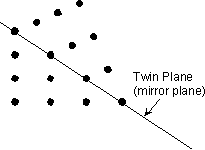
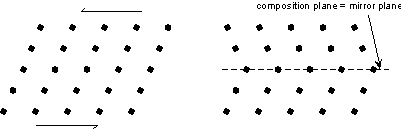
What happens is that lattice points in one crystal are shared as lattice points in another crystal adding apparent symmetry to the crystal pairs.  Twinning, because it adds symmetry, never occurs in relation to the existing symmetry of the crystal.
Symmetry Operations that Define Twinning
Because symmetry is added to a crystal by twinning, twining can be defined by the symmetry operations that are involved.  These include:
  • Reflection across a mirror plane.  The added mirror plane would then be called a twin plane.
  • Rotation about an axis or line in the crystal.  The added rotation axis would then be called a twin axis.
  • Inversion through a point.  The added center of symmetry would then be called a twin center.

Twin Laws
Twin laws are expressed as either form symbols to define twin planes (i.e. {hkl}) or zone symbols to define the direction of twin axes (i.e. [hkl]).
The surface along which the lattice points are shared in twinned crystals is called acomposition surface.


If the twin law can be defined by a simple planar composition surface, the twin plane is always parallel to a possible crystal face and never parallel to an existing plane of symmetry (remember that twinning adds symmetry).
If the twin law is a rotation axis, the composition surface will be irregular, the twin axis will be perpendicular to a lattice plane, but will never be an even-fold rotation axis of the existing symmetry.  For example twinning cannot occur on a new 2 fold axis that is parallel to an existing 4-fold axis.

Types of Twinning

Another way of defining twinning breaks twins into two separate types.
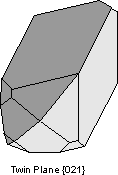
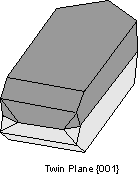
  1. Contact Twins - have a planar composition surface separating 2 individual crystals. These are usually defined by a twin law that expresses a twin plane (i.e. an added mirror plane). An example shown here is a crystal of orthoclase twinned on the Braveno Law, with {021} as the twin plane.
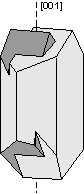
  1. Penetration Twins - have an irregular composition surface separating 2 individual crystals.  These are defined by a twin center or twin axis.  Shown here is a twinned crystal of orthoclase twinned on the Carlsbad Law with [001] as the twin axis.
Contact twins can also occur as repeated or multiple twins. 
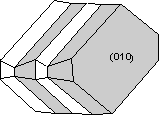
  • If the compositions surfaces are parallel to one another, they are calledpolysynthetic twins.  Plagioclase commonly shows this type of twinning, called the Albite Twin Law, with {010} as the twin plane.  Such twinning is one of the most diagnostic features of plagioclase.
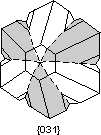
  • If the composition surfaces are not parallel to one another, they are calledcyclical twins.  Shown here is the cyclical twin that occurs in chrysoberyl along a {031} plane.


Origin of Twinning

Twinning can originate in 3 different ways, as growth twins, transformation twins, and glide or deformation twins.
  1. Growth Twins - When accidents occur during crystal growth and a new crystal is added to the face of an already existing crystal, twinning can occur if the new crystal shares lattice points on the face of the existing crystal, but has an orientation different from the original crystal.  Such growth twins can be contact twins, as illustrated here, or can be penetration twins. All of twins discussed so far are growth twins.
 
  1. Transformation Twins - Transformation twinning occurs when a preexisting crystal undergoes a transformation due to a change in pressure or temperature.  This commonly occurs in minerals that have different crystal structures and different symmetry at different temperatures or pressures.  When the temperature or pressure is changed to that where a new crystal structure and symmetry is stable, different parts of the crystal become arranged in different symmetrical orientations, and thus form an intergrowth of one or more crystals.  Dauphiné and Brazil twinning in quartz commonly forms this way during a decrease in temperature.  

    Similarly the combination of albite twinning and pericline twinning in alkali feldspar results when high temperature sanidine (monoclinic)  transforms to low temperature microcline (triclinic). This type of twinning is only observed using the polarizing microscope, and results in a "tartan" twinning pattern as shown in your text book on page 231, figure10.18.  When this twinning pattern is observed with the microscope it is one of the most characteristic diagnostic properties for the identification of microcline. 
 
  1. Deformation Twins -  During deformation atoms can be pushed out of place. If this happens to produce a symmetrical arrangement, it produces deformation twins.  The mineral calcite can be easily twinned in this way, producing polysynthetic twins on {012}.


Common Twin Laws
  • Triclinic System - The feldspar minerals plagioclase and microcline are the most common triclinic minerals that show twinning.  Two common twin laws are observed in these feldspars.

  • Albite Law - As described above, plagioclase (NaAlSi3O8 - CaAl2Si2O8) very commonly shows albite polysynthetic twinning.  The twin law - {010} indicates that the twining occurs perpendicular to the bcrystallographic axis. Albite twinning is so common in plagioclase, that it's presence is a diagnostic property for identification of plagioclase. 

  • Pericline Law - The pericline law has [010] as the twin axis.  As stated above, pericline twinning occurs as the result of monoclinic orthoclase or sanidine transforming to microcline (all have the same chemical formula - KAlSi3O8).  Pericline twinning usually occurs in combination with  albite twinning in microcline, but is only observable with the polarizing microscope.  The combination of pericline and albite twinning produce a cross-hatched pattern, called tartan twinning, as discussed above,  that easily distinguishes microcline from the other feldspars under the microscope. 
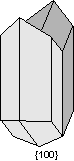
  • Monoclinic System - The most common twins in the monoclinic system occur on the planes {100} and {001}.  The feldspars - orthoclase and sanidine - are the most commonly twinned minerals in the monoclinic system.  Both contact twins and penetration twins occur, and both types result from accidents during growth.

  • Manebach Law - {001} - forms a contact twin commonly observed in the mineral orthoclase. This twinning is very diagnostic of orthoclase when it occurs.  

  • Carlsbad Law - [001] - forms a penetration twin in the mineral orthoclase. Crystals twinned under the Carlsbad Law show two intergrown crystals, one rotated 180ofrom the other about the [001] axis. Carlsbad twinning is the most common type of twinning in orthoclase, and is thus very diagnostic of orthoclase when it occurs.

  • Braveno Law - {021} - forms a contact twin in the mineral orthoclase.  

  • Swallow Tail Twins - {100}- are commonly observed in the mineral gypsum (CaSO4.2H2O).
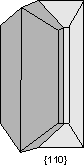
  • Orthorhombic System - Orthorhombic crystals commonly twin on planes parallel to a prism face.  The most common is a {110} twin that results in many orthorhombic minerals having cyclical twins.

  • {110} Cyclical Twins - The mineral aragonite (CaCO3) , chrysoberyl (BeAl2O4), and cerrusite (PbCO3) commonly develop twinning on {110}.  This results in a cyclical twin which gives these minerals a pseudo-hexagonal appearance.

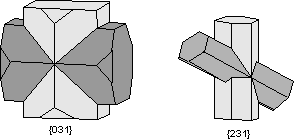
  • Staurolite Law - The mineral staurolite is really monoclinic, but it has a ß angle very close to 90o so it has the appearance of an orthorhombic mineral.  Two types of interpenetration twins occur in staurolite the {031} twins from a right-angled cross and the {231} twins form a cross at about 60o.


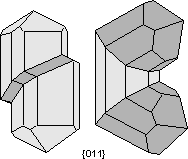
  • Tetragonal System - Twinning in the tetragonal system usually occurs on {011} forming cyclical contact twins.  The minerals rutile (TiO2) and cassiterite (SnO2)  commonly show this type of twinning.
  • Hexagonal System - The minerals calcite (CaCO3) and quartz (SiO2) are the most common hexagonal minerals and both show the types of twinning common in hexagonal minerals.

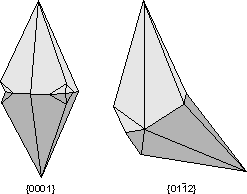
  • Calcite Twins - The two most common twin laws that are observed in calcite crystals are {0001} and the rhombohedron {012}.  Both are contact twins, but the {012} twins can also occur as polysynthetic twins that result from deformation.
Quartz shows three other hexagonal twins.
  • Brazil Law - {110} - is a penetration twin that results from transformation. 
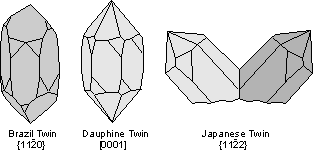
  • Dauphiné Law - [0001] - is also a penetration twin that results from transformation.
  • Japanese Law - {112} - is a contact twin that results from accidents during growth.
  • Isometric System - Three types of twins are common in the isometric system.

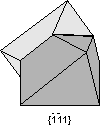
  • Spinel Law - {1} - is a twin plane, parallel to an octahedron.  It occurs commonly in mineral spinel (MgAl2O4).

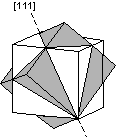
  • [111] - The twin axis perpendicular to an octahedral face adds three fold rotational symmetry. 

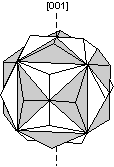
  • Iron Cross [001] - The mineral pyrite (FeS2) often shows the iron cross made of the interpenetration of two pyritohedrons.  Since this occurs in the class 2/m, with no 4-fold rotation axes, the [001] twin axis gives the mineral apparent 4-fold symmetry about 3 perpendicular axes.
Polymorphism
Polymorphism means "many forms".  In mineralogy it means that a single chemical composition can exist with two or more different crystal structures.  As we will see when we look more closely at crystal structures, if a crystal is subjected to different pressures and temperatures, the arrangement of atoms depends on the sizes of the atoms, and the sizes change with temperature and pressure.  In general, as pressure increases the volume of a crystal will decrease and a point may be reached where a more compact crystal structure is more stable. The crystal structure will then change to that of the more stable structure, and a different mineral will be in existence.  Similarly, if the temperature is increased, the atoms on the crystal structure will tend to vibrate more and increase their effective size.  In this case, a point may be reached where a less compact crystal structure is more stable.  When the crystal structure changes to the more stable structure a different mineral will form.  
The change that takes place between crystal structures of the same chemical compound are called polymorphic transformations.
 Types of Polymorphic Transformations
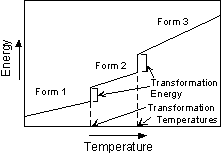
Stability of crystal structures is generally referred to in terms of the energy of the crystal structure.  In general terms this can be thought of as the bond strength (enthalpy), and entropy (degree of order or randomness) of the structure.  In general, the structure with the lowest energy is the most stable at any given temperature and pressure. 
This results in three types of transformations.
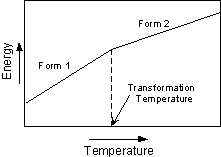
  1. Reconstructive Transformations - these involve extensive rearrangement of the crystal structure and requires breaking of chemical bonds and reassembling the atoms into a different crystal structure.  This usually involves a large change in energy of the structure which must occur at the transformation temperature or pressure.  Because of the extensive rearrangement involved, the rate at which this type of transformation occurs may be very slow.  If the rate of the transformation is very slow, unstable polymorphs (metastable) may exist for long periods of time.  

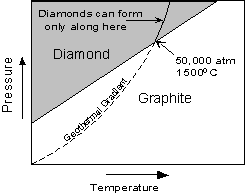
For example, diamond is a metastable polymorph of Carbon at the pressures and temperatures present at the Earth's surface, yet, as the saying goes "diamonds are forever".  Not really, it's just that the rate at which diamond can rearrange its crystal structure to become graphite, the polymorph stable at low P and T, is very slow at the low temperatures found near the Earth's surface.
  1. Displacive Transformations - these involve only small adjustments to the crystal structure.  Generally no bonds are broken, but the angles between the atoms may change slightly.  Because there is little rearrangement, displacive transformations involve no change in energy at the transformation temperature or pressure, and the transformations are instantaneous and reversible.  Thus, no unstable polymorphs will occur.

For example, at 1 atmosphere pressure high quartz (a quartz) is the stable form of quartz above 580o C.  When high quartz is brought to a temperature below 580o it immediately is transformed into low quartz (b quartz).  Thus, high quartz is never seen in rocks at the surface of the Earth.
 
  1. Order - Disorder Transformations - these involve the state of order or disorder in a crystal structure.  Perfect order can only occur at a temperature of absolute zero (-273oC).  As temperature increases, the degree of order or randomness of a crystal structure decreases, so that the higher temperature forms of minerals are more disordered than the lower temperature forms.  Because the state of order-disorder changes gradually with increasing temperature, there is no definite temperature at which a transformation occurs.

    An example of polymorphic transformations that involve order-disorder is the compound KAlSi3O8.  At high temperature the stable form is Sanidine (Monoclinic).  At lower temperature the structure changes to one of orthoclase (also Monoclinic), and at even lower temperature the structure becomes that of the more ordered structure of microcline (also Triclinic).

    There is no definite temperature at which Sanidine changes to orthoclase or orthoclase changes to Microcline, since the structure changes gradually as temperature decreases. If the temperature change is rapid, then unstable polymorphs can continue to exist a low temperature.

Important Polymorphs
Many common minerals show polymorphism.  We here look at some of the more common ones.
 
  • Carbon - has two polymorphs.  At high pressure carbon has an isometric crystal structure that is called diamond.  As temperature and/or pressure are decreased diamond should undergo a reconstructive transformation to the hexagonal structure of graphite.  Because this transformation involves a drastic rearrangement of atoms on the crystal structure, as evidenced by the fact that diamond is the hardest naturally occurring substance and graphite is one of the softest) diamond is found at the T & P conditions present at the Earth's surface, where it is therefore only metastable.
      
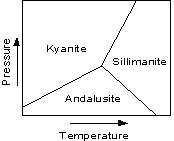
  • Al2SiO5  - has three polymorphs.  The high pressure form is kyanite (Triclinic), the high temperature form is sillimanite (orthorhombic), and the low temperature, low pressure form is andalusite (orthorhombic).  Transformations between all three polymorphs are reconstructive, thus all three forms can metastably exist at the Earth's surface.  Transformation rates are somewhat faster, however, at higher temperatures in the Earth.
  • CaCO3  - has two polymorphs.  The high pressure form is aragonite (orthorhombic) and the low pressure form is calcite (hexagonal).  The transformation between the two polymorphs is reconstructive, so metastable polymorphs can exit.
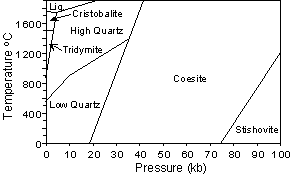
  • SiO2 - has 6 polymorphs.  With decreasing temperature at low pressure, cristobalite (isometric) undergoes a reconstructive transformation to tridymite (hexagonal).  Further lowering of temperature results in tridymite undergoing a reconstructive transformation to high quartz (also hexagonal).  Lowering temperature further results in high quartz undergoing a displacive transformation to low quartz.

Cristobalite and tridymite can exist metastably at the low temperatures near the Earth's surface, and thus are found in rocks.  But high quartz will also transform to low quartz before it reaches temperatures present at the Earth's surface, so it is never found in rocks.

With increasing pressure, at low temperature low quartz undergoes a displace transformation to coesite (Monoclinic), and coesite undergoes a reconstructive transformation to stishovite (tetragonal) at even higher pressures.  Thus, coesite and stishovite have metastable polymorphs that can be found in rocks.
  • KAlSi3O8 - As discussed above, this compound has three polymorphs that undergo order-disorder transformations with lowering of temperature.  The high temperature polymorph is sanidine (monoclinic).  It is usually only found in volcanic rocks that have cooled very rapidly so that a higher state of order is not achieved.  With slower cooling, sanidine eventually undergoes a transformation to orthoclase (also monoclinic), and orthoclase eventually transforms to microcline (triclinic) with further slow cooling.
Polytypism
Polytypism is a type of polymorphism wherein different polymorphs exist in different domains of the same crystal.  It has to do with the way that individual layers are stacked within a crystal structure.  Polytypism has little geologic consequence, and will thus not be discussed further here.
 
Metamict Minerals
Metamict minerals are minerals whose crystal structure has been partially destroyed by radiation from contained radioactive elements.  The breakdown of the crystal structure results from bombardment of a particles emitted by the decay of U and Th radioactive isotopes.  
The mineral zircon (ZrSiO4) often has U and Th atoms substituting for Zr in the crystals structure.  Since U and Th have radioactive isotopes, Zircon is often seen to occur in various stages of metamictization.  


Mineraloids
By definition, a mineral has to have an ordered atomic arrangement, or crystalline structure.  There are some Earth materials that fit all other parts of the definition of a mineral, yet do not have a crystalline structure.  Such compounds are termedamorphous (without form).
Some of these amorphous compounds are called mineraloids.  These usually form at low temperatures and pressures during the process of chemical weathering and form mammillary, botryoidal, and stalactitic masses with widely varying chemical compositions.  Limonite [FeO.(OH).nH2O] and allophane ( a hydrous aluminum silicate) are good examples.
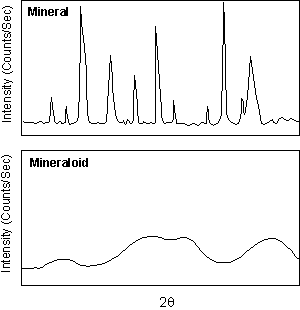
Others like volcanic glass and opal (SiO2.nH2O) have short-range order or domains wherein some crystalline-like order exists.Unlike crystalline minerals that show sharp, well defined x-ray diffraction peaks, these mineraloids with short-range order show broad diffraction peaks that give evidence of the short-range order. 
Pseudomorphism
Pseudomorphism is the existence of a mineral that has the appearance of another mineral.  Pseudomorph means false form.  Pseudomorphism occurs when a mineral is altered in such a way that its internal structure and chemical composition is changed but its external form is preserved.  Three mechanisms of pseudomorphism can be defined:
  1. Substitution.  In this mechanism chemical constituents are simultaneously removed and replaced by other chemical constituents during alteration.  An example is the replacement of wood fibers by quartz to form petrified wood that has the outward appearance of the original wood, but is composed of quartz.  Another example is the alteration of fluorite which forms isometric crystals and is sometimes replaced by quartz during alteration.  The resulting quartz crystals look isometric, and are said to be pseudomorphed after fluorite.
  2. Encrustation.  If during the alteration process a thin crust of a new mineral forms on the surface of a preexisting mineral, then the preexisting mineral is removed, leaving the crust behind, we say that pseudomorphism has resulted from encrustation.  In this case the thin crust of the new mineral will have casts of the form of the original mineral. 
  3. Alteration.  If only partial removal of the original mineral and only partial replacement by the new mineral has taken place, then it is possible to have a the space once occupied entirely by the original mineral be partially composed of the new mineral.  This results for example in serpentine pseudomorphed after olivine or pyroxene, anhydrite (CaSO4) pseudomorphed after gypsum (CaSO4.2H2O), limonite [FeO.(OH).nH2O] after pyrite (FeS2), and anglesite (PbSO4) after galena (PbS).

Examples of questions on this material that could be asked on an exam
  1. Define the following :  (a) Twinning, (b) twin plane, (c) twin axis, (d) composition surface, (e) contact twin, (f) penetration twin.
  2. What are three ways that twinning can originate?
  3. Why can't twinning occur parallel to axes or planes of existing symmetry in a crystal.
  4. Define polymorphism.
  5. Give several examples of minerals that show polymorphism, being sure to name all of the polymorphs.
  6. Describe that three different types of transformations that result in new polymorphs.
  7. Define the following: (a) metamict mineral, (b) pseudomorphism, (c) mineraloid.